

Selective Outrage or Silent Treatment? Nate Lewis Questions Why a Coach’s Firing Over Alleged Misconduct Barely Registers in Sports Media—And What ESPN’s Quiet Says About Who Gets Scrutiny, Who Gets Protected, and Why Fans Are Starting to Notice.
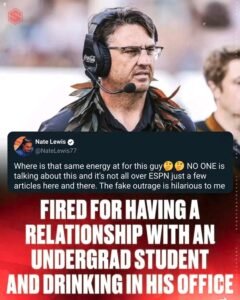
Nate Lewis’s critique taps into a growing frustration among sports fans: the sense that outrage in sports media is not applied evenly. When a coach is fired amid allegations of an inappropriate relationship with an undergraduate student and reports of drinking in his office, many would expect wall-to-wall coverage, especially in an era where accountability and institutional culture are frequent talking points. Instead, as Lewis points out, the story seemed to pass with relatively muted national attention, particularly compared to other scandals that dominate headlines for weeks.
At the heart of Lewis’s argument is not the claim that every controversy deserves the same level of airtime, but that the standards for determining “newsworthiness” appear inconsistent. Sports media outlets, especially large ones like ESPN, often frame themselves as watchdogs of ethics, culture, and power in athletics. When similar cases in the past have triggered extensive debate panels, investigative features, and social media campaigns, silence—or near silence—raises understandable questions.
One possible explanation is context. Media coverage is influenced by timing, the profile of the coach or program, the clarity of the allegations, and whether there is documented evidence or ongoing legal action. Editors may decide a story is too localized, too legally sensitive, or too underdeveloped to justify heavy national coverage. From that perspective, the lack of saturation is a judgment call rather than a cover-up.
However, Lewis’s critique resonates because fans have seen how selectively these judgment calls can feel. Some figures are scrutinized intensely for personal failings, while others seem to fade quietly out of view. That perceived inconsistency fuels cynicism about whether media outlets are driven by principle or by ratings, relationships, and brand protection. When fans sense that power, prestige, or market size influences who gets exposed and who gets ignored, trust erodes.
It’s also worth noting how social media has changed expectations. In a digital landscape where controversies spread rapidly and audiences actively compare coverage across cases, silence becomes more noticeable. What once might have gone unnoticed now feels deliberate, even if it isn’t.
Ultimately, Lewis’s critique is fair in the sense that it raises a legitimate question, not a definitive accusation. Sports media does not operate in a vacuum, and uneven coverage doesn’t automatically imply bad faith. Still, transparency about why certain stories are amplified while others are minimized would go a long way toward restoring credibility. Fans aren’t just consuming sports anymore—they’re evaluating the storytellers too.
