

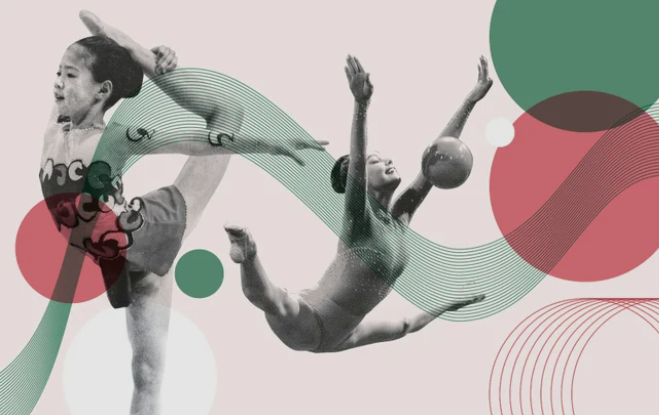
Bent, Broken, and Brilliant: How Rhythmic Gymnastics Stole My Childhood
I learned to point my toes before I learned long division. By seven, my world revolved around mirrors, music, and the sharp snap of ribbons slicing the air. Rhythmic gymnastics was sold to me as grace — glittering leotards, sparkling apparatus, applause like warm rain. But behind the shimmer lived something harder, stranger, and far more consuming.
Training began after school and ended long after dark. Flexibility was currency; pain was proof of commitment. We stretched until our hamstrings trembled and our backs arched into shapes that felt less human than ornamental. Coaches spoke the language of perfection — straighter knees, higher extensions, tighter turns — and we translated it into self-criticism. Every dropped hoop felt like a moral failure. Every wobble, a public confession of inadequacy.
There was absurdity, too. Fake eyelashes on a ten-year-old. Hairspray clouds thick enough to choke. Smiling while your calves burned and your ribs ached. We performed innocence with professional precision. Parents filmed routines as if documenting destiny, while we measured our worth in tenths of a point.
Yet brilliance bloomed in the brutality. I learned discipline before distraction, resilience before rebellion. I understood that mastery is built from repetition so relentless it borders on madness. On the competition floor, under the lights, time slowed. The music swelled. For ninety seconds, I was not a child contorted by expectation but an artist commanding space.
Still, childhood slipped quietly between training sessions and tournaments. Birthday parties were missed; weekends dissolved into rehearsals. I grew up bent toward perfection, broken by comparison, yet made strangely brilliant by survival.
Rhythmic gymnastics did not simply shape me. It claimed me — and in losing parts of childhood, I gained a complicated kind of strength.
