

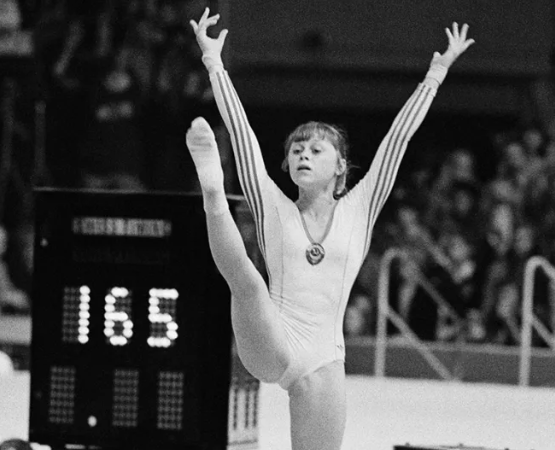
Elena Mukhina: The Soviet Gymnast Who Was Pushed Beyond the Limit—While Simone Biles Had the Power to Say No
In the high-stakes world of Olympic gymnastics, courage is often measured in medals. But sometimes, the greatest act of bravery is knowing when to stop.
Elena Mukhina was once the pride of the Soviet Union—a world champion whose daring routines electrified audiences in the late 1970s. Coached under a system that demanded absolute obedience and superhuman resilience, Mukhina was driven to attempt increasingly dangerous skills in preparation for the 1980 Moscow Olympics. Among them was the perilous Thomas salto, a move so risky it has since been banned from women’s competition.
In July 1980, just weeks before the Games, Mukhina under-rotated the skill in training. The result was catastrophic: a broken neck that left her quadriplegic at just 20 years old. She would spend the rest of her life paralyzed, a haunting symbol of a sporting machine that prized glory over human limits.
Decades later, at the Tokyo Olympics, Simone Biles shocked the world by withdrawing from several events, citing mental health concerns and a dangerous condition known as the “twisties.” Critics were swift. Supporters were louder. But the contrast was unmistakable.
Biles had the autonomy to say “no.” Mukhina did not.
The difference was not in talent or toughness—both women were extraordinary. The difference lay in power. One competed in a rigid, state-controlled system where dissent was unthinkable. The other, though under immense pressure, stood in an era that increasingly recognizes athlete welfare and personal agency.
Mukhina’s tragedy remains a stark reminder of what can happen when ambition eclipses humanity. Biles’ defiance marks a turning point—proof that strength is not only about risking everything, but sometimes about refusing to.
